


Percy's Panorama 🔍The Edge of Chaos: What Nobody Is Telling You About Anxiety, Control, and the Dog You Think You Know
Percy's Panorama is an occasional long-form investigation into the topics that matter. This week, Percy examines why "anxiety" has become the most overused and least understood word in dog behaviour — and why the thing causing it might be closer to home than you think.

I want to begin with a confession of mild frustration.
The word anxiety has been doing an enormous amount of heavy lifting in the dog behaviour world, and nobody seems to have noticed that it is buckling under the weight.
We say a dog is anxious.
We note it down.
We proceed as if "anxious" is the destination rather than a signpost pointing somewhere else entirely.
What caused it?
What is sustaining it?
What would actually help?
These questions receive considerably less airtime than they deserve.
I also want to say something that may make some of you uncomfortable. The cause of that anxiety is sometimes the training. Not the type of training. Not the method. The underlying model of what a dog is and what training is for. I will come back to this, because it matters more than almost anything else I will say today.
But first, foundations. Without them, the rest will not make sense.
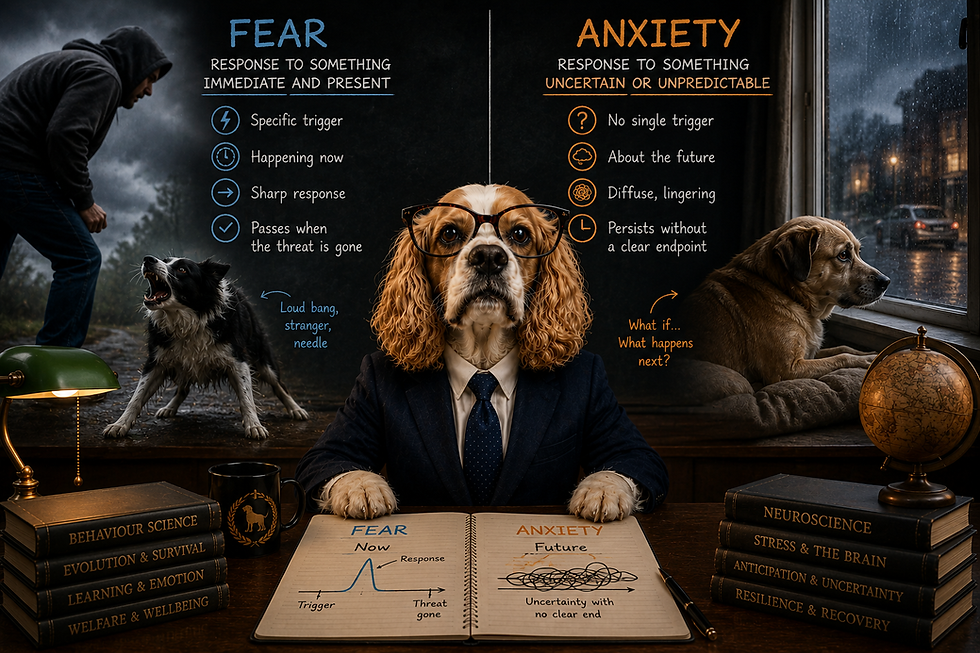
Fear and anxiety are not the same thing
This sounds obvious. It is not, because most people use the words interchangeably, and doing so causes genuine harm.
Fear is a response to something immediate and present. The loud bang. The stranger approaching too fast. The vet's needle. Fear is sharp, specific, and — in a healthy nervous system — it passes when the thing causing it passes. It is, in the proper evolutionary sense, a feature. It keeps animals alive.
Anxiety is different in a fundamental way. Anxiety is about anticipation. It is the emotional state that arises not from what is happening now, but from uncertainty about what might happen — or from a persistent sense that whatever happens, the animal has no meaningful influence over it. Anxiety is future-oriented. It is often diffuse, with no single identifiable trigger. You cannot point at the thing causing it and remove it, because the thing causing it is the uncertainty itself.
This distinction matters enormously in practice. A dog experiencing fear and a dog experiencing anxiety can look identical from the outside — the same tension, the same shutdown, the same inability to engage.
But they require completely different responses. Treating anxiety as if it were fear, and fear as if it were anxiety, is one of the most reliable ways to make both worse.
Anxiety is also frequently a symptom rather than a diagnosis.
When we say a dog is anxious, we have described a state.
We have not explained it.
We have not asked what produced it, what is sustaining it, or what the dog actually needs. "Anxious" as a destination, rather than as a starting point for investigation, tells us almost nothing useful.
This is the gap I am here to address.

What the science says — and what it doesn't
The research literature on canine anxiety is thinner than it should be, and it is heavily skewed toward one end of the problem.
Most of what we know comes from studies on aversive training methods, shelter environments, and veterinary handling — all valuable, but all examining a relatively narrow slice of how anxiety is produced in dogs.
What the science does tell us clearly is this: control matters.
Not control in the sense of obedience or compliance, but control in a deeper sense — the dog's experience of whether its own behaviour makes a meaningful difference to what happens next.
The foundational research here is uncomfortable to read. In the 1960s, Seligman and Maier exposed dogs to electric shocks they could not escape or avoid. Later, when escape became possible, many of those dogs did not try.
They had learned, at a physiological level, that their behaviour made no difference — and that learning persisted even when the situation changed. They had stopped trying. The researchers called it learned helplessness, and it is arguably the clearest demonstration in any species that loss of control is not merely unpleasant but genuinely destabilising, in ways that outlast the original experience.
We would not conduct those experiments today. But their implications have never gone away.
More recent and more ethical work points in the same direction.
Studies comparing reward-based and aversive training methods consistently find that dogs trained with aversive methods show more stress-related behaviours, higher stress hormones after training sessions, and — most tellingly — a more pessimistic cognitive bias.
This last finding deserves explanation. Researchers can measure a dog's emotional state by presenting them with something ambiguous — a bowl in the middle of the room that might contain food or might not — and observing whether the dog approaches it hopefully or avoids it cautiously.
Dogs that have experienced more aversive training tend to assume the worst. Their baseline expectation of the world has shifted toward negative. That is not fear of a specific trigger. That is anxiety as a settled state.
Zoo welfare science has contributed something important here too. Researchers studying captive animals now make careful distinctions between choice — having options — control — being able to influence what happens through your own behaviour — and predictability — being able to anticipate what is coming.
These sound similar but they are meaningfully different. A dog can have a highly predictable routine and still have no real control. A dog can be offered apparent choices that change nothing meaningful. Real agency requires all three working together: options, influence, and the ability to anticipate.
The evidence across species is consistent.
Animals that can influence their environment, predict what is coming, and remove themselves from what overwhelms them are healthier animals. Those that cannot — regardless of whether the restriction is deliberate or structural — show the physiological and behavioural markers of chronic stress.
In humans, the research is most fully developed.
A large body of clinical evidence shows that perceived control — the belief that you can influence what happens to you, or at least manage your own response to it — is one of the strongest protective factors against anxiety disorders. Reduce that sense of control, and anxiety follows. Restore it, and anxiety reduces.
This has been demonstrated not just as a correlation but as a mechanism.
The human developmental literature adds a critical layer. Parental overcontrol — restricting a child's autonomy, making decisions for them, not allowing them to navigate difficulty independently — is associated with higher anxiety in children and adolescents.
The child never develops the internal resource to manage uncertainty, because uncertainty has always been managed for them. Their sense of mastery — the accumulated experience of "I tried something, it worked, I can influence my world" — never fully develops.
We have no equivalent longitudinal research in companion dogs. That gap is not small. It is the size of a field. What we have instead is a mechanistic argument — well-supported across species — and the accumulated clinical experience of people who work closely with dogs. That is what I am drawing on today.

Road one: the anxiety of too much control
Let me be precise about what I mean, because this is where the discomfort begins.
The obvious version of this problem is aversive training — dogs managed through punishment, correction, and suppression. The research on this is clear enough: coercive methods restrict agency, create unpredictability, and produce the kind of chronic stress that shifts a dog's baseline toward anxiety.
A dog that has learned that its behaviour produces mostly negative outcomes will eventually stop trying to influence its world. That is learned helplessness, and it is a form of anxiety.
But I want to talk about a less obvious version, because the obvious version lets too many people off the hook.
You can produce the same outcome — a dog without internal resource, without the capacity to solve problems or navigate uncertainty independently — using the kindest, most reward-based, most technically accomplished training in the world. If the underlying model is wrong.
The model I am describing is one that most trainers and owners have never examined, because it is so embedded in how we think about training that it has become invisible. It is the model of the dog as an operated system. The handler as the decision-maker. The dog as the device that executes those decisions. Every behaviour on cue. Every situation navigated through instruction. The dog is never wrong, because the dog is never really choosing — it is always waiting to be told.
This dog can look extraordinary. Responsive, attentive, impeccably behaved. In contexts where the handler is present and the instruction set covers the situation, it functions perfectly.
But remove the handler, or introduce a situation the instruction set doesn't cover, and the dog has nothing.
No experience of solving problems independently.
No confidence in its own judgement.
No sense that its own behaviour, unprompted, can produce good outcomes.
It has been trained into a sophisticated dependence that looks, from the outside, like competence.
I find this model objectionable on a number of levels, and I say that as a dog who loves to train. Training, done well, is one of the most interesting and rewarding things a dog can do. It develops the mind. It builds communication. It creates genuine partnership.
But the goal of good training is not a dog that executes instructions. It is a dog that can think — that has built enough internal resource, enough experience of its own agency, enough confidence in its own problem-solving, that it can navigate the world as a sentient, intellectual being rather than a well-programmed peripheral device.
The trained-into-dependence dog is anxious for the same fundamental reason as the coerced dog: its behaviour does not reliably produce meaningful outcomes from its own volition.
One has been punished into passivity. The other has been rewarded into waiting. The emotional destination is closer than most people want to admit.
I have watched trainers of considerable technical skill, using exclusively positive methods, produce dogs so thoroughly managed that they have no idea what to do with themselves when the session ends.
I have watched owners so devoted to their dogs, so attentive to every need, so determined to make every experience positive, that the dog has never once had the experience of navigating something difficult and coming through it.
These are not negligent owners. They are loving owners applying a model of training and care that nobody has ever asked them to question.
I am asking them to question it now.

Road two: the anxiety of too little structure
Here is the other road, the less discussed one, and the one that runs entirely counter to what most people assume about dog welfare.
Give a dog that needs structure unlimited unstructured freedom, and you produce anxiety.
Not the anxiety of suppression. The anxiety of a navigation system that has been handed a map of the entire world and asked to find its own way without a destination.
This is not a universal statement about all dogs. It is a statement about a real subset of dogs whose nervous systems are simply not built for unstructured autonomy — and whose distress is routinely misread because it does not fit the familiar model of the over-controlled animal.
Take herding breeds. Border Collies, German Shepherds, Belgian Malinois — dogs engineered over generations for precision work alongside humans, for taking direction, executing it with intelligence, and operating within a clear framework of expectation.
These dogs are not diminished by structure. Structure is part of what they are.
A Border Collie given unlimited freedom in an environment with no clear role, no clear expectation, no clear framework — is not a liberated Border Collie. It is a Border Collie trying to manage the anxiety of a world it cannot organise.
I observe this in Jim, my Border Collie colleague — and I use the word colleague because there is very little else one can call him, despite his limited conversational range.
Jim does not want to decide what happens next and if he did the rest of the world might not like the descisions he comes to, hes not like me.
He wants to know what is expected, execute it with precision, and be confirmed in that execution. Unstructured freedom does not free Jim. It burdens him with decisions he was never designed to make alone, in an environment he cannot make sense of without a framework to hang it on.
I have observed similar patterns in German Shepherds — dogs that present as anxious, reactive, or difficult, where the presenting behaviour dissolves when the owner learns to provide clear, consistent structure. Not control in the sense of suppression. Structure in the sense of predictability, clear expectation, and a human the dog can genuinely orient to.
The spaniels are the counterpoint, and they make the argument beautifully by contrast. A well-bred working spaniel needs productive chaos in its life. The unpredictability of a hunt, the variable environment, the need to make rapid independent decisions in the field — this is not stress for a well-adjusted spaniel. It is the fullest expression of what the spaniel is.
Micromanage a spaniel into compliance, suppress its independent decision-making, require it to wait for instruction before it acts — and you create frustration and anxiety through the suppression of the very thing the dog was built to do.
But here too, the point is not a simple breed prescription. It is a spectrum.
Every individual dog sits somewhere on that spectrum, shaped by breed, by individual temperament, by age, by the environment they are in, by the experiences they have accumulated. The same dog may function well in one context and show significant anxiety in another, not because the dog has changed, but because the environment is making different demands on the dog's coping capacity.
The right question is never "how much freedom should dogs have?" The right question is "where does this dog find their edge — and are we helping them find it?"

A word about ethograms, which most of you will never have heard of
Bear with me. This is important and I will make it accessible.
Zoo welfare science uses the concept of an ethogram — the full vocabulary of behaviours that a species is naturally built to perform.
Not just feeding and sleeping, but everything: hunting, social interaction, play, exploration, problem-solving, communication, territorial behaviour, the whole range.
A welfare scientist assessing an animal does not simply ask "is this animal calm?" They ask: "Is this animal expressing an appropriate spread of the behaviours it is built for, across a reasonable range of contexts?"
Think of it like language. A person who can only ever say yes or no is not communicating. An animal that can only express a fraction of its natural behavioural range — because the rest has been suppressed, or never developed, or has no outlet — is not thriving. Regardless of how quiet and manageable it appears.
Good welfare, in this framework, is not the absence of difficulty or the absence of problem behaviour. It is a rich, varied, species-appropriate behavioural life. The animal doing what it was designed to do, in appropriate measure, in appropriate contexts.
We rarely apply this framework to companion dogs, and I think that is a significant oversight.
A dog that never uses its nose is not a well dog.
A dog that never solves problems is not a well dog.
A dog that never navigates uncertainty and develops its own coping capacity is not a well dog — however loved, however managed, however apparently content.
The dog operated as a device fails this measure. The dog managed into passivity fails it. But so does the dog given so much unstructured freedom that it can never settle into the behavioural patterns it was actually built for. Welfare is not a quantity of freedom. It is a quality of expression.
A long time ago Dad actually done some research on the canine ethogram, he will tell you his work is not finished, but what he started is secretly hidden away in a dark corner of Dog Smarts website, so dont tell him I shared this with you, but you can have a look here

Chaos theory: the part where mathematics becomes useful
I am aware this may seem like a detour. It is not.
Chaos theory is a branch of mathematics concerned with complex systems — systems that follow rules but are extraordinarily sensitive to their starting conditions.
Small differences at the beginning produce enormous differences in outcome over time.
The famous illustration is the butterfly effect: a butterfly flapping its wings in Brazil creates a tiny disturbance in air currents that, amplified through a vast and complex system, eventually influences a weather event on the other side of the globe.
Not magic.
Not randomness.
Just sensitivity to initial conditions, operating through a complex system over time.
Dogs are complex adaptive systems. Dog-raising is full of butterfly effects that we almost entirely fail to account for.
Two puppies, same litter, apparently identical starting point.
One is raised by a handler who reads them — who adjusts the balance of structure and freedom to what that individual dog needs, who responds to the dog's signals, who calibrates as the dog develops and as the environment changes.
The other is raised by someone applying a fixed formula. It worked with the last dog. It is what they know. A tiny difference in initial management. A potentially enormous difference in what that dog becomes.
The chaos is not in the dog. It is in the sensitivity of the developmental system to those early calibrations.
Chaos theory also gives us a concept I find particularly illuminating: strange attractors.
In complex systems, behaviour tends to orbit around certain stable states — the system gets disturbed, but it keeps returning to the same patterns.
A well-calibrated dog has a healthy attractor: challenge it, disturb it, and it returns to a settled, functional baseline.
A dog whose sense of agency has been chronically disrupted — whether by overcontrol, by trained dependence, or by the anxiety of too much unstructured freedom — loses that stable attractor.
It becomes genuinely unpredictable. Not because anything is fundamentally wrong with the dog, but because the system has been pushed out of its stable orbit and cannot easily find its way back.
And then there is what complex systems researchers call the edge of chaos — the zone between complete order and complete randomness where complex adaptive systems are most functional, most flexible, most capable of learning and adapting.
Fully ordered systems become rigid and brittle.
Fully chaotic systems become unnavigable.
The richest, most adaptive behaviour — in organisms, in ecosystems, in organisations — tends to emerge right at that edge.
Every dog has an edge. For Jim, the edge sits close to the order end of the spectrum — and my job, and his owner's job, is to help him find it and remain there.
For a well-bred working spaniel, the edge sits considerably further toward productive chaos — and a handler's job is to create conditions where that chaos is generative rather than overwhelming.
For most dogs, the edge is somewhere between those two points, and it shifts across the course of a lifetime.
Both roads to anxiety — the road of too much control and the road of too little structure — arrive at the same destination: a dog who has been pushed off their edge and cannot find it again.

What this means in practice
I am not in the habit of offering simple prescriptions. The situation does not support them.
What I will say is this.
The next time you encounter an anxious dog — or look at your own dog and wonder why they seem unsettled, or shut down, or unable to cope independently — the questions worth asking are not just "what is this dog afraid of?"
They are:
Where does this dog sit on the spectrum between needing structure and needing autonomy?
Are they getting enough of what they actually need, or what we assume they need?
Is this dog capable of solving problems without being told what to do?
Has it ever been given the opportunity?
Does it have experience of its own behaviour producing good outcomes from its own volition — not because it was instructed, but because it decided?
Has this dog been trained, however kindly, into a model where the handler is the operating system and the dog is the device?
And if so, what would it take to begin building genuine internal resource?
Is this dog's environment calibrated to who this dog actually is — their breed, their individual temperament, their developmental stage — or to a general idea of what dogs need?
The research base for all of this is thinner than it should be. We have strong mechanistic evidence from learned helplessness research, from aversive training studies, from zoo welfare science, and from human developmental psychology.
We have almost no direct longitudinal evidence specifically examining the anxiety produced by trained dependence, or by the mismatch between a dog's individual need for structure or autonomy and the life they are actually living.
That research needs to exist. It does not yet.
In its absence, we work from first principles, careful observation, and the experience of people who have spent serious time with serious numbers of dogs.

In conclusion
Anxiety is not fear. It is a state produced by persistent uncertainty and a diminished sense of influence over what happens next.
It can be produced by stripping away agency through coercion and aversive management.
It can be produced by training that, however kindly intended, installs dependence rather than capability.
It can be produced by giving a dog more unstructured freedom than their nervous system is equipped to navigate.
Different roads. The same destination.
Every dog has an optimal zone on the spectrum between order and autonomy — an edge of chaos specific to them, shaped by breed, temperament, environment, and accumulated experience.
Good welfare is not the absence of difficulty. It is a dog expressing its full behavioural vocabulary, appropriately, within a framework calibrated to who that dog actually is.
The butterfly effect is real. Small differences in how we manage a dog's environment — in how we think about what training is for, in whether we are building a thinking being or an operated device — produce outcomes that diverge far more than we expect.
That is not a counsel of despair. It is an argument for precision, for attentiveness, for treating each dog as the complex, sensitive, individual system they actually are.
I have been Percy.
I think for myself.
I always have.
I was raised that way, and I am the better for it.
Good day to you all.
Percy's Panorama is an occasional long-form investigation into the topics that matter. Percy is a Cavicockerpug of significant intellectual standing and wishes it noted that he reviewed this piece before publication and found it both accurate and appropriately worded, which is more than he can say for most of what he reads.
Dog Smart Training & Behaviour | All content is evidence-informed and reviewed for accuracy. Percy reviewed it for tone.
References
Learned helplessness — the foundational dog studies Overmier, J.B. & Seligman, M.E.P. (1967). Effects of inescapable shock upon subsequent escape and avoidance responding. Journal of Comparative and Physiological Psychology, 63(1), 28–33. Seligman, M.E.P. & Maier, S.F. (1967). Failure to escape traumatic shock. Journal of Experimental Psychology, 74(1), 1–9.
Aversive training, stress behaviours, cortisol and pessimistic cognitive bias Vieira de Castro, A.C. et al. (2020). Does training method matter? Evidence for the negative impact of aversive-based methods on companion dog welfare. PLOS ONE, 15(12). Casey, R.A. et al. (2021). Canine training activities and their relationship to problem behaviours in dogs: a UK-based cohort study. Frontiers in Veterinary Science, 8.
Heart rate variability distinguishing anxious from non-anxious dogs Wormald, D. et al. (2017). Dog behaviour problems and owner representation of human–dog relationship. Applied Animal Behaviour Science, 188, 69–77.
Insecure attachment and acute cortisol response Riggio, G. et al. (2022). Effect of attachment style and owner–dog relationship on stress in dogs. Animals, 12(3).
Perceived control and anxiety in humans — meta-analysis Gallagher, M.W., Bentley, K.H. & Barlow, D.H. (2014). Perceived control and vulnerability to anxiety disorders. Cognitive Therapy and Research, 38(6), 571–584.
Parental overcontrol and child anxiety — meta-analysis van der Bruggen, C.O., Stams, G.J.J.M. & Bögels, S.M. (2008). Research review: the relation between child and parent anxiety and parental control. Journal of Child Psychology and Psychiatry, 49(12), 1257–1269.
Zoo welfare — choice and control as core welfare variables Englund, O. et al. (2023). Choice and control in zoo animal welfare. Animals, 13(3). Rust, N.A. et al. (2024). Experimental choice-based welfare studies in captive animals — a scoping review. (scoping review, journal TBC from full source)
Giant pandas, enclosure choice and cortisol Owen, M.A. et al. (2005). Giant pandas in captivity: the effect of space use and exhibition on adrenocortical activity. Zoo Biology, 24(5), 449–463.
Rhesus macaques and husbandry predictability Gottlieb, D.H. et al. (2013). Effects of predictability in the husbandry of rhesus macaques. Applied Animal Behaviour Science, 147(1–2), 261–271.
A note on sources and synthesis
The research references listed above represent the peer-reviewed evidence base that underpins the empirical claims in this piece. They can be checked, challenged, and read in full — Percy encourages this, because he has read them and found them broadly satisfactory.
The sections on chaos theory, strange attractors, and the edge of chaos draw on established principles from complexity science and dynamical systems theory rather than from canine-specific research. These are not analogies invented for the occasion — they are legitimate scientific frameworks being applied to a domain that has not yet thought to use them. The absence of a dog study citing Lorenz or Strogatz is a gap in the dog literature, not in the framework. Percy notes this without apology.
The application of these frameworks to individual variation in dogs — the idea that each dog has an optimal zone on the order-to-chaos spectrum — is the authors' synthesis, informed by clinical experience and the mechanistic literature on agency, control, and welfare. It is a hypothesis supported by convergent evidence rather than a finding from a single study. That is how good hypotheses begin.
Readers interested in the foundational chaos and complexity science are directed to Gleick, J. (1987) Chaos: Making a New Science, and Strogatz, S. (2003) Sync: How Order Emerges from Chaos in the Universe, Nature, and Daily Life — both written for general audiences and both, Percy suspects, considerably more readable than most of the canine welfare literature.


Comments